Majori. Jomas Street – The Town’s Promenade

The name Jomas Street derives from the Latvian word joma, a wind-formed depression between dunes.
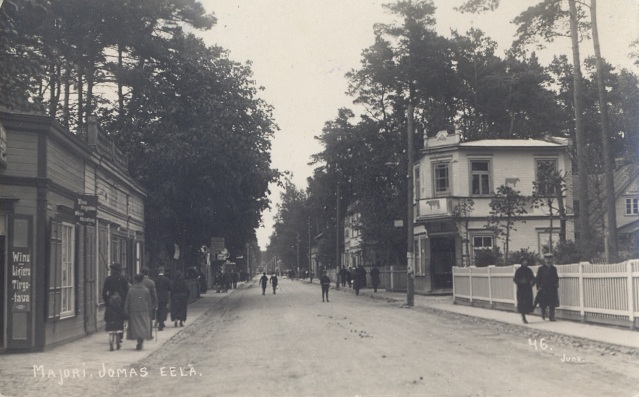
The street began to take shape in the mid-19th century, when the Riga seaside area, later to become the city of Jūrmala, was only beginning to develop as a resort destination. Laid out between two natural dune ridges, it connected Majori with Avoti, later known as Edinburgh and today as the Dzintari district.
From the outset, Jomas Street became the resort's principal thoroughfare. Shops, guesthouses, hotels, a pharmacy, Horn's Hotel with its concert garden, and an Orthodox church lined the street. At the corner of Jomas and Tirgoņu Streets stood Majori's first market, where both residents and summer visitors could purchase food and everyday necessities.
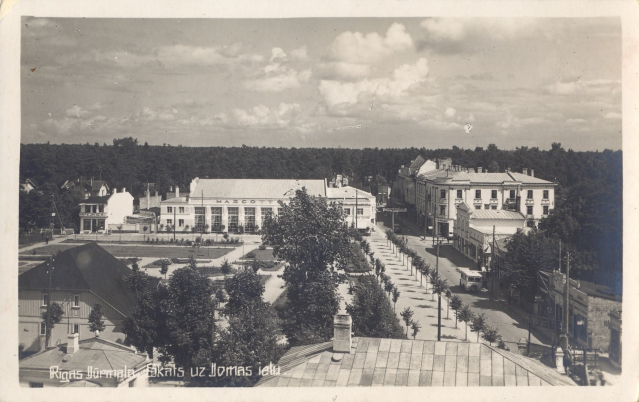
During Latvia's first period of independence (1918–1940), Jomas Street evolved into the town's main promenade and social meeting place. People came here to stroll, shop, enjoy a coffee or an ice cream, and take part in the lively resort atmosphere. The street retained its importance throughout the Soviet era.
Even during the interwar years, traffic along Jomas Street was restricted because pedestrians were disturbed by the noise and exhaust fumes from cars and motorcycles. In 1975, a major redevelopment programme was launched to make the street more comfortable and accessible for pedestrians.
In 1987, Jomas Street officially became a pedestrian zone. Decorative flower planters were installed, the distinction between roadway and pavement was removed, and new paving slabs were laid. Distinctive multi-globe street lamps, popularly known as "dandelions", illuminated the promenade, while benches provided places to sit and linger.
A further reconstruction followed in 2003, when decorative paving stones replaced the earlier surface. In 2024, a new lighting system was installed along the street.
Open the route in Google Maps.
1. MAJORI RAILWAY STATION
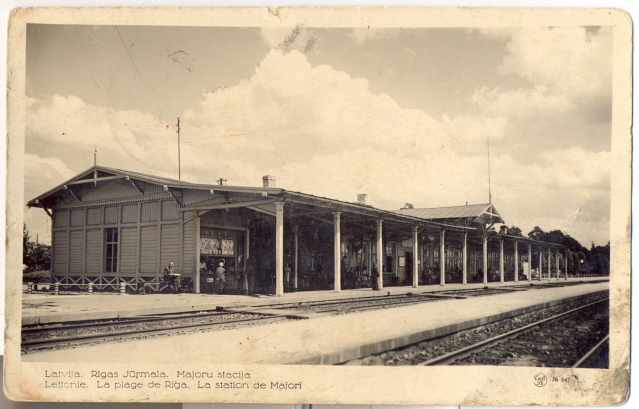
Majori Railway Station, originally known as Majorenhoff, opened in 1877 together with the Riga–Tukums railway line.
The historic station building featured an elegant restaurant beneath a covered canopy, complete with large indoor plants and tables dressed in white tablecloths.
The station was far more than a transport hub. It housed passenger service facilities, administrative offices and technical rooms. The canopy protected travellers from rain and wind, while seasonal ticket offices and waiting areas operated during the summer months. In winter, passengers could use heated waiting rooms accessible both from the platform and the town side of the station.
The complex also included a buffet, newspaper kiosk, luggage facilities and various utility buildings.
Its wooden architecture echoed the traditional summer cottages of the Riga seaside and contributed significantly to the resort's distinctive character. Reflecting the railway architecture of its time, the station showcased fine craftsmanship and high-quality materials. For this reason, it was recognised as an important cultural and historical landmark and included in the list of locally protected architectural monuments.
In the 1990s, a decision was made to demolish the historic station building. Several architectural competitions explored possible concepts for a new station, including pedestrian tunnels, overhead walkways, underground access to the Lielupe riverside and extensive alterations to the surrounding street network.
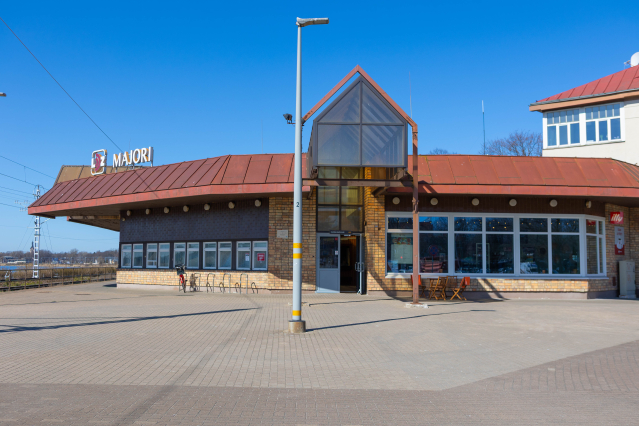
The present station building was completed in 1992. The demolition of the historic station and the removal of its protected status sparked considerable public debate among residents, architects and historians. Located in the heart of the city, Majori Station has long remained one of Jūrmala's most recognisable landmarks.
The new station was designed by specialists from the Riga Design and Research Institute of the Baltic Railway. Its defining feature is a large glazed skylight that extends beyond the building and marks the main entrance. This architectural element continues through the lobby and leads naturally towards the platform exit.
Traditional materials were chosen throughout the project, including yellow brick, brown ceramic tiles, anodised aluminium and timber. The waiting hall offers views across the meadows of the Lielupe River. The design also responds thoughtfully to Baltic weather conditions. To minimise draughts, the main entrance was positioned on the side of the building rather than directly opposite another doorway. The original design additionally included a pedestrian underpass beneath the main road, but this element was never realised due to its high cost.
One reminder of the former station still survives – its historic clock. Carefully restored, it is now preserved in the Latvian Railway History Museum.
2. JOMAS STREET 26
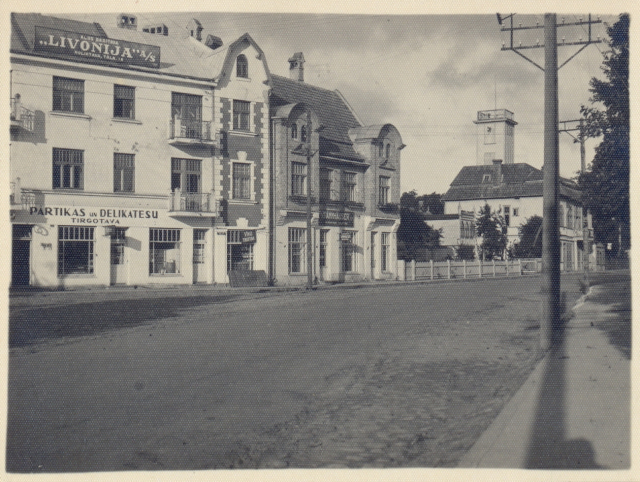
Near the building at Jomas Street 28, on the site now occupied by a small car park, the depot of the Majori Volunteer Firefighters Association was built in 1908.
The depot ceased operations after the Second World War, and around 1950 the building was demolished.
3. JOMAS STREET 28
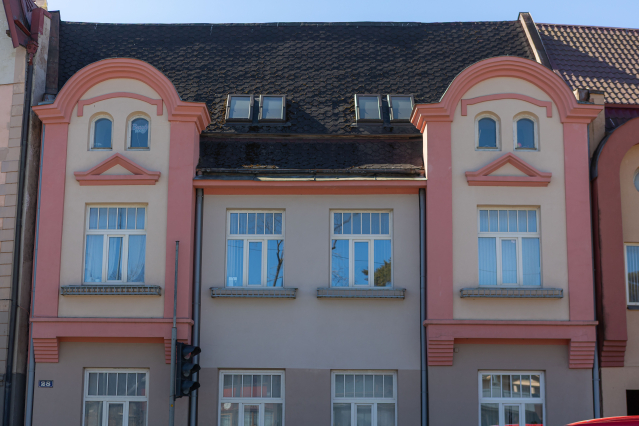
During Latvia's first period of independence, the building housed a wine shop owned by Jānis Hauzers.
During the Soviet era, it became home to the Jūrmala branch of Latvenergo. In the 1960s, the Majori Civil Registry Office and the Housing Administration were also located here.
4. JOMAS STREET 30
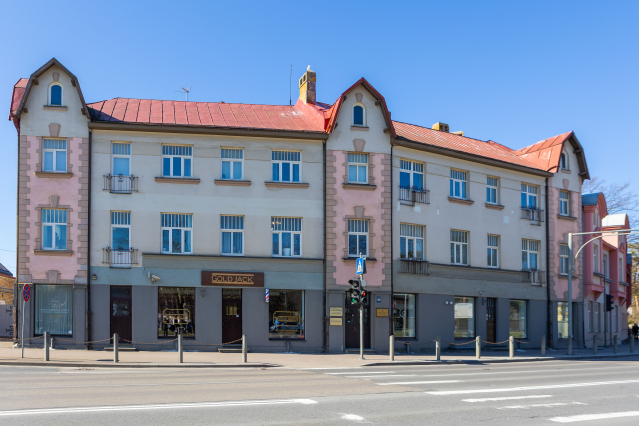
This residential building was constructed in the early 20th century by Jānis Cauka (1877–1933) and his wife Anna (1878–1966).
Particular attention was paid to the foundations. Large fieldstones were used to ensure the building could withstand the frequent floods and storms associated with the nearby Lielupe River. Unlike many of Jūrmala's traditional timber houses, the property was built of brick with exceptionally thick walls. After completing the original structure, the owners acquired the neighbouring property and added a second section.
Construction was supervised by builder Kārlis Mellenbergs, father of architect Viktors Mellenbergs, who would later design Dzintari Concert Hall. Viktors Mellenbergs himself, while serving as Jūrmala's chief architect, rented an apartment on the third floor between 1933 and 1938.
Following Jānis Cauka's death, the property passed to Maria, Anna's daughter from her first marriage. In 1923, Maria married Arnolds Belte (1894–1940), the son of former Jūrmala mayor Pēteris Belte.
In the autumn of 1944, as the Second World War drew to a close, Maria Belte and her daughter fled Jūrmala. Almost all of their possessions were left behind. The beverage shop on the ground floor, offices on the second floor and other premises remained empty. Fearing repression and deportation, the family escaped to Germany.
According to family recollections, Maria buried silver valuables before leaving, hoping to return after the war. She never did. Maria Belte died in Canada in 1999 at the age of ninety-nine. Jānis Cauka, Anna Cauka and Arnolds Belte are buried in Vecdubulti Cemetery.
During the Soviet period, the property was nationalised. A household goods store occupied the ground floor, a savings bank operated on the second floor, and various municipal offices were located on the third floor.
Maria Belte regained ownership of the property in 1994. After her death, the building was inherited by her grandchildren, who sold it in 2015. Today, the ground and second floors are occupied by various businesses, while apartments remain on the upper floor.
5. SQUARE WITH THE LĀČPLĒSIS STATUE
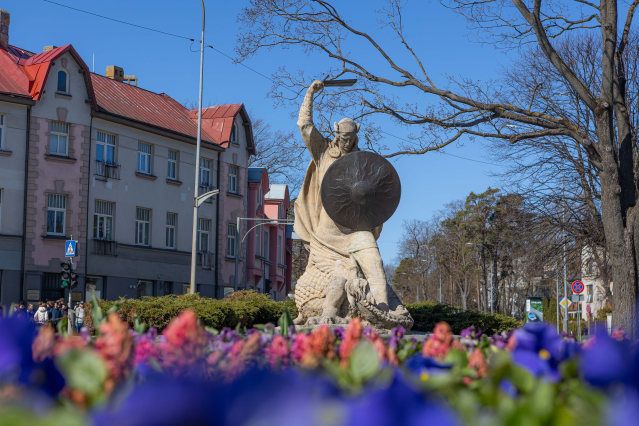
The square opposite Majori Railway Station marks the historic beginning of Jomas Street.
This open space emerged after the devastating fire of 1913. Before that, the site was occupied by several buildings, including the area's first pharmacy, established in 1877 by the Dubulti pharmacist Kilpe.
In 1953, the sculpture Lāčplēsis ("Bear-Slayer") was installed here. Created by sculptors Leonīds Kristovskis and Vladimirs Rapiķis, the monument is made of stone and concrete and features a metal sword and shield. Originally, it functioned as a fountain, complete with a basin, decorative frogs and water flowing from the dragon's mouth.
The sculpture has an unusual history. Around 1950, a statue of Saint George was commissioned in Latvia for Georgia. Saint George is one of Georgia's most important national symbols and appears on the country's coat of arms. When the completed sculpture was rejected by the client, the artists altered the figure in order to save the work. A new headpiece was added, a sword placed in the figure's hands, and the pose was modified. As a result, Saint George was transformed into Latvia's legendary hero Lāčplēsis.
Traces of the original concept, however, remain visible. In Andrejs Pumpurs' epic poem, Lāčplēsis battles a three-headed monster, whereas this sculpture depicts him fighting a single-headed dragon.
The monument was restored in 2003, when the square itself also underwent renovation.
In 2020, a contemporary environmental artwork entitled Jūrmala's White Seagull was installed nearby. Created by sculptor Kristaps Gulbis, the work features four bronze seagulls perched on a park bench.
Visitors can also see the fountain Horizon, designed by sculptor Inta Berga and architect Andris Kronbergs. In 2009, it received Latvia's Design Award in the Urban Design Objects category.
6. JOMAS STREET 27
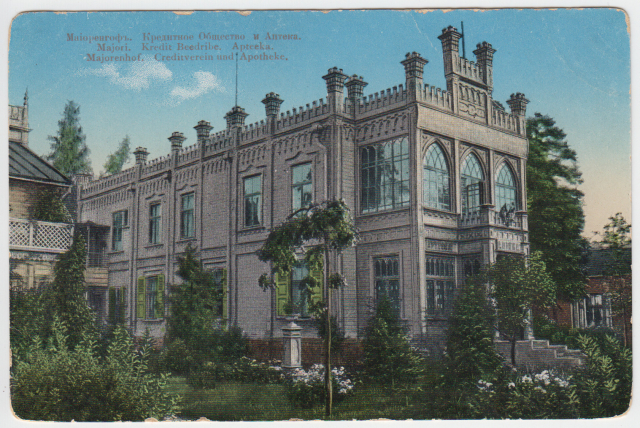
At the beginning of the 20th century, this site was occupied by a striking Neo-Gothic building belonging to pharmacist and public figure Ernst Zēbergs.
It is believed that in July 1904 the building hosted an exhibition of Baltic artists. Eight artists presented around eighty works, including paintings by renowned Latvian masters Vilhelms Purvītis and Jānis Rozentāls. Contemporary newspapers record that Ernst Zēbergs was among the exhibition's principal organisers and made rooms in his summer residence available for the event.
The building also housed the pharmacy operated by E. Zēbergs and G. Janson.
In 1913, it was destroyed in the great fire that consumed numerous buildings on both sides of Jomas Street.
7. JOMAS STREET 29 – FORMER HOTEL MAJORI
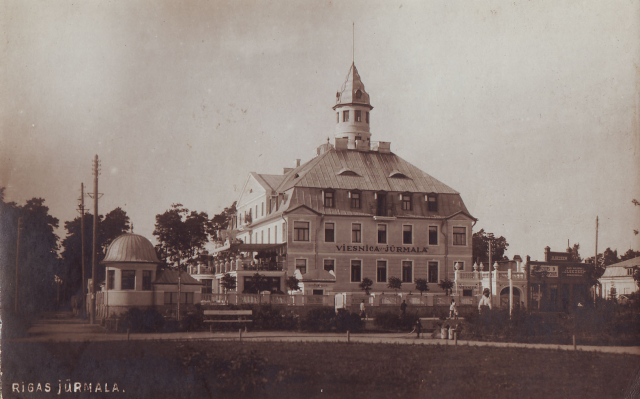
The former Hotel Majori, built in 1925, is a state-protected architectural monument. Until the 1970s, it was known as Hotel Jūrmala.
Designed by architect Artūrs Mēdlingers as an elegant resort hotel, the complex contained more than sixty guest rooms, four halls, terraces, landscaped gardens and a fountain park. Its architecture combines Historicist, Neo-Classical and Neo-Baroque elements.
The complex consists of a two-storey masonry building with an attic floor, towers, corner pavilions, service buildings and a stone perimeter fence. One of its most distinctive features was a tower with a viewing platform.
The hotel promoted itself as a modern holiday destination, offering sunny guest rooms, a first-class restaurant, a breakfast buffet, a pastry shop, garden terraces and live music.
Every afternoon, guests could attend the traditional English-style "Five O'Clock Tea Dance", enjoying tea, music and dancing. The hotel quickly became one of the resort's leading social centres, hosting balls, club evenings and various cultural events.
During the economic crisis of the 1930s, the hotel went bankrupt and remained vacant for several years before being acquired by the Riga Mortgage Bank.
When the new nine-storey Hotel Jūrmala opened in 1974, the historic property was renamed Hotel Majori.
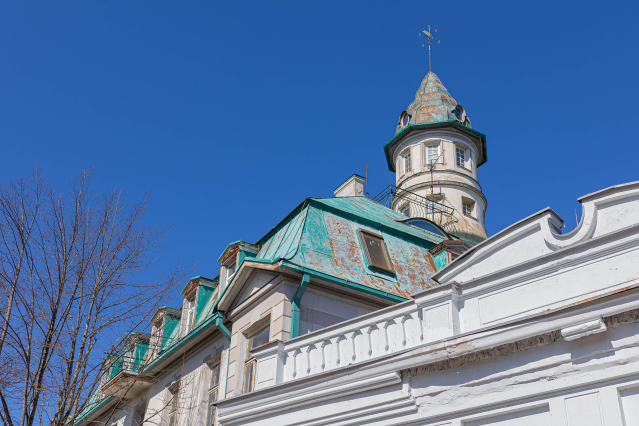
Between 1997 and 1999, the building underwent extensive reconstruction. A passenger lift was installed, while the restaurant, kitchen and lobby were modernised. However, the original stone fence facing Jomas Street was lost during these works.
Today, the building remains in private ownership and no longer functions as a hotel.
8. JOMAS STREET 33
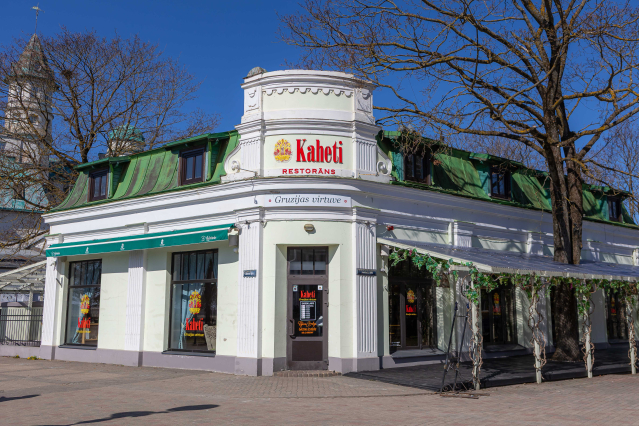
At the beginning of the 20th century, a summer cottage with a small shop stood on this site. The building was destroyed by fire during the winter of 1914.
A one-storey commercial building was later constructed in its place and served a variety of functions over the decades. In the 1930s, it operated as a warehouse for the Iļģuciems brewery. During the 1950s, it became a grocery store.
In 1968, the beer bar Sencis opened here. Instead of a traditional signboard, a beer barrel hung above the entrance, while the interior was decorated in a distinctly Latvian style.
During the 1980s, a petrol station operated in the courtyard, accessible from Omnibusa Street.
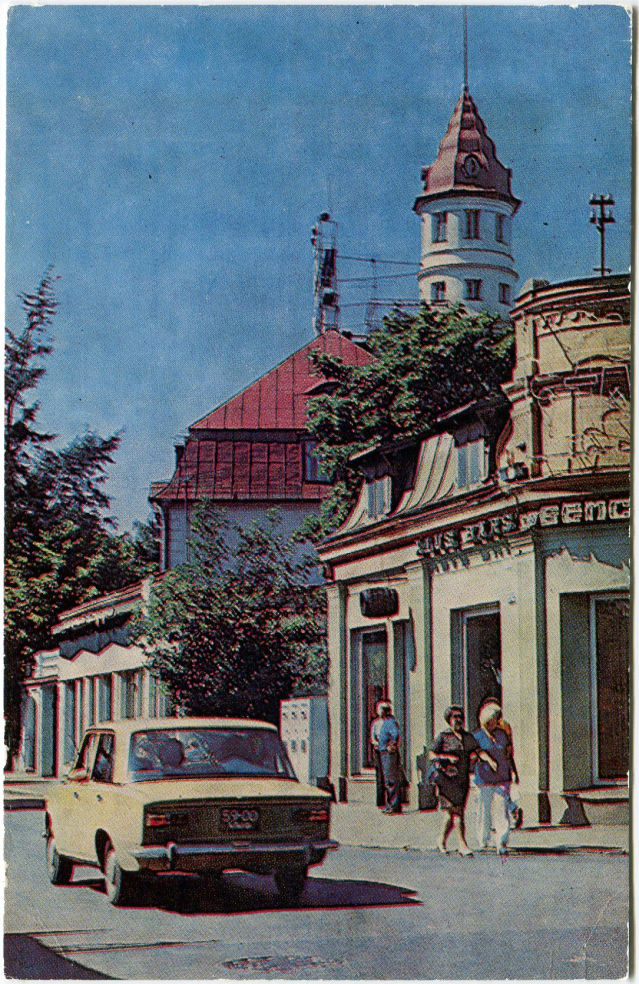
Following reconstruction in 1993, the restaurant Orients Sultāns opened on the premises. Its owner and head chef, Aleksandrs Useinovs, was one of Jūrmala's best-known culinary figures. He began his career in 1968 as an apprentice at the legendary restaurant Jūras Pērle and later became head chef of the renowned restaurant Uzbekistāna.
Orients Sultāns quickly gained popularity and remained here until 2008. Today, the building houses the Georgian restaurant Kaheti.
9. JOMAS STREET 35 – HORN'S GARDEN
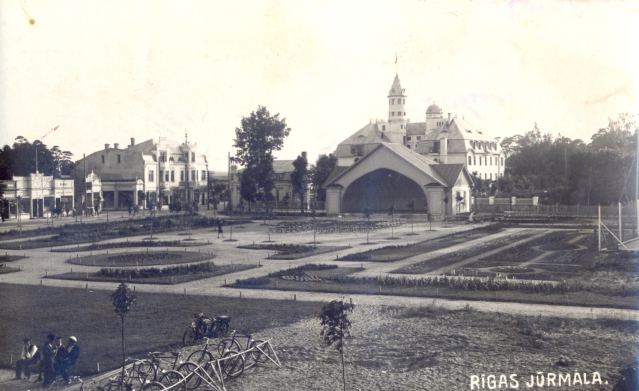
In 1870, this area was still covered by dunes and young pine trees. The first tenant of the plot was Albert Horn (1833–1893), whose name survives in the title of the garden.
In the late 19th century, Horn established a hotel, restaurant, cinema, concert hall and open-air concert garden here. With seating for more than 2,000 people, the concert garden became the social heart of Majorenhoff. It was particularly renowned for its high-quality symphonic concerts, although balls, celebrations and public gatherings were also regularly held here.
The venue gained additional fame for its impressive electric lighting, considered highly modern for its time.
In 1905, Horn's Garden hosted the first major Latvian music concert conducted by Juris Jurjāns.
During the concert, Kārlis Baumanis' song God Bless Latvia was performed. The composition later became Latvia's national anthem. Contemporary accounts describe such large crowds that some musicians reportedly had to climb over the fence to reach the stage.
On 28 August 1913, a devastating fire broke out in a building at the corner of Jomas and Tirgoņu Streets. The flames spread rapidly, destroying all of Horn's Garden and many surrounding buildings.
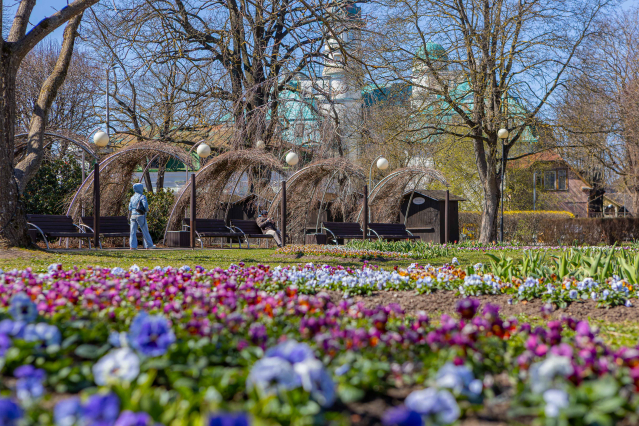
During the 1920s and 1930s, public gardens were created on the site. A new open-air stage was built, and an avenue of linden trees was planted along Jomas Street. Concerts continued here until 1936.
Today, Horn's Garden once again serves as a venue for cultural events and summer concerts. A small gazebo marks the location of the former open-air stage, while decorative bronze seagull sculptures can be found throughout the park.
10. JOMAS STREET 35 – JŪRMALA CULTURE CENTRE
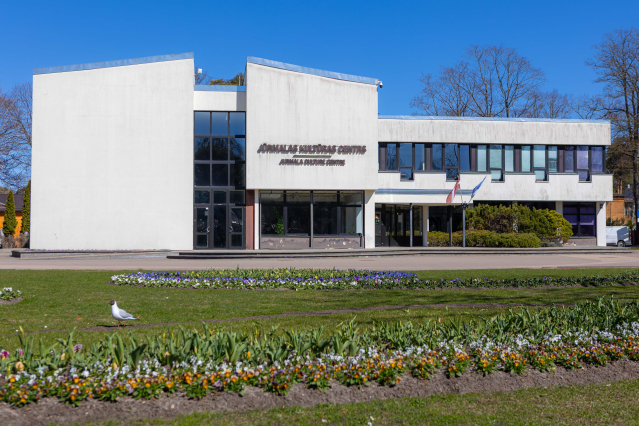
The present building was constructed in 1964 as a widescreen cinema with seating for 500 visitors.
Between 1974 and 1977, the cinema Jūrmala underwent extensive reconstruction. New facilities included Aeroflot airline ticket offices on the second floor and the café Aero on the ground floor.
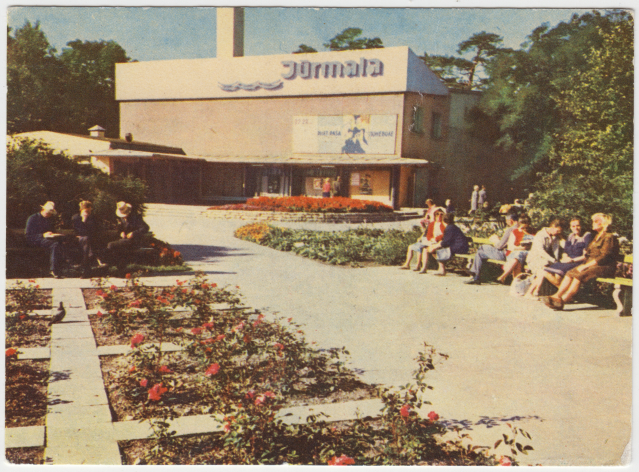
The café served German, French and Italian cuisine, including julienne, pizza, Hamburg-style sandwiches, ice cream and cocktails. Its interior was particularly distinctive. Silver-toned wall panels and illuminated stained-glass elements were created by artists from the association Māksla, while the waitresses wore uniforms inspired by those of airline stewardesses.
Today, the building serves as the Jūrmala Culture Centre, hosting concerts, dance performances and art exhibitions.
11. JOMAS STREET 36
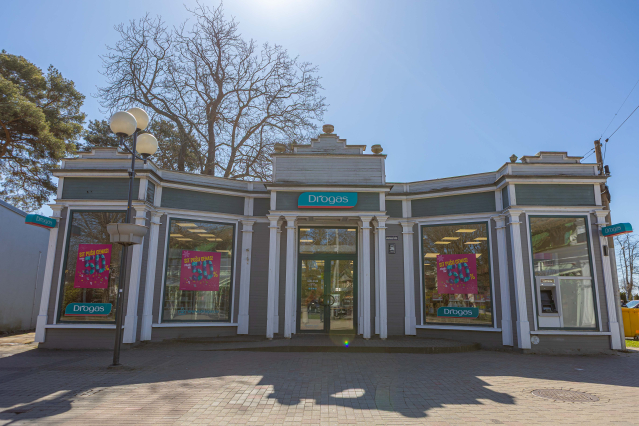
This commercial building was erected around the turn of the 20th century. Its symmetrical façade features Neo-Classical decorative elements, including columns and ornamental vases.
At the beginning of the century, the premises housed Skribanovic's Ladies' Goods and Handicrafts Shop.
The building was one of the few structures to survive the devastating Horn's Garden fire of 1913 and has continuously served commercial purposes ever since.
Since 2002, it has been occupied by the health and beauty retailer Drogas. The building is protected as a local architectural monument.
12. JOMAS STREET 40
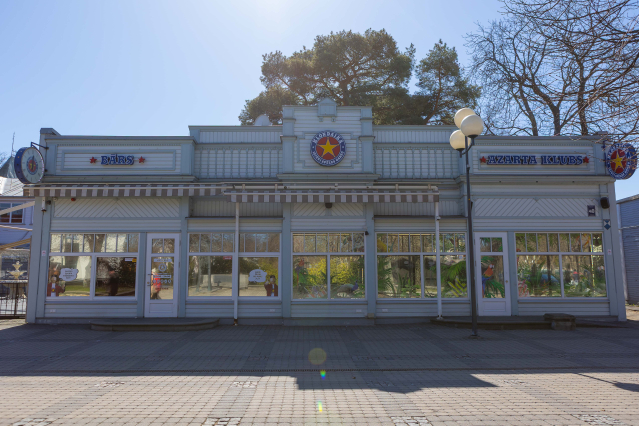
This building was constructed after the great fire of 1913. It originally housed a shop selling household goods, paints, decorating supplies and wallpaper.
The business belonged to the Remņev family, merchants who settled in Riga during the mid-19th century. Before the First World War, the family operated several stores and invested extensively in real estate in both Riga and Jūrmala.
Members of the family were also active in public life. Nikolai Remņev served as senior warden of the Orthodox Church of Saints Peter and Paul in Dubulti.
During the Soviet period, the building housed a sporting goods store. Over time it has undergone several restorations and alterations.
Today, it remains a protected local architectural monument.
13. THE LITTLE RAVEN SCULPTURE
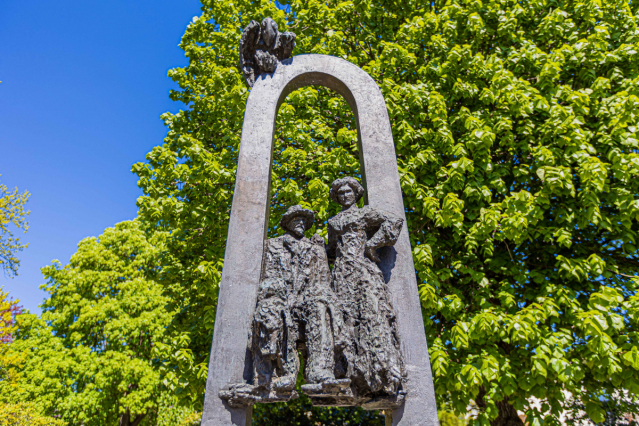
The sculpture The Little Raven was unveiled in 1990 to mark the 125th anniversaries of Latvia's celebrated poets Rainis and Aspazija.
The monument commemorates their appearance at a poetry and song evening held in Horn's Garden in July 1905. It also references their years of exile in Switzerland and Rainis' 1917 play The Little Raven.
A raven figure crowns the monument, which was created by artists Zigrīda Fernava-Rapa and Juris Tiščenko-Rapa.
14. JOMAS STREET 42 – MAJORENHOFF RESTAURANT
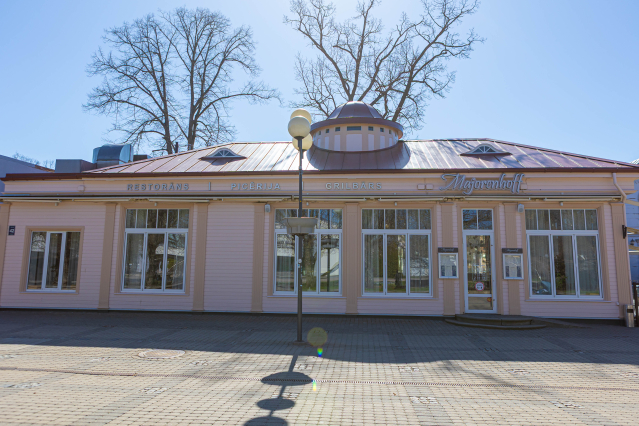
In the 1930s, this address was home to Kārlis Šameitke's restaurant. Contemporary promotional brochures advertised it as the "First-Class Majori Restaurant", with an entrance from Tirgoņu Street, live music from six in the evening until midnight, quality beverages, dishes prepared by first-class chefs and pastries baked in its own bakery.
Today, the tradition of hospitality continues at this location through the restaurant Majorenhoff, whose name pays tribute to the historic origins of Majori.
15. JOMAS STREET 44
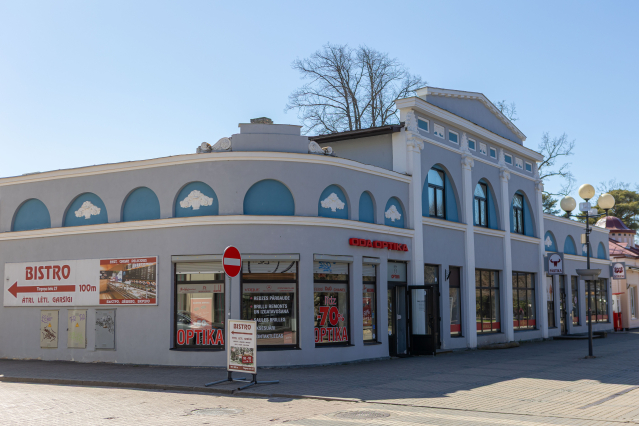
This masonry building, distinguished by a two-storey central section, is an example of Historicist, or Neo-Classical, architecture, featuring richly decorated street façades. It is protected as a local architectural monument.
Around 1930, the building housed J. Shirjajev's colonial goods store, A. Akerman's book and stationery shop, a fashion store and a hairdresser's salon.
During the Soviet period, particularly in the 1950s and 1960s, the premises operated as a department store and became one of the largest grocery stores in Majori. To accommodate the needs of holidaymakers, it remained open every day without weekends or lunch breaks.
A simplified restoration of the building's façade was carried out in 2020.
16. JOMAS STREET 42, BUILDING NO. 3 – GUESTHOUSE
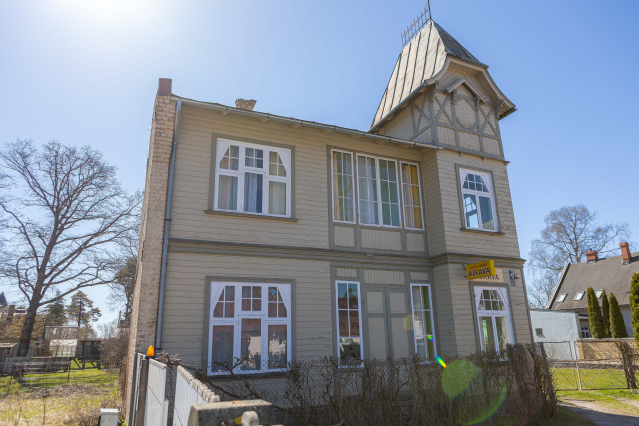
Located deeper within the property are several historic summer cottages and boarding-house buildings.
A notable architectural feature is Building No. 3, characterised by an asymmetrical Art Nouveau composition and a distinctive corner tower. In the post-war years, it formed part of the Majori holiday home complex.
Today, the building operates as the Airava Guesthouse. The residential building at Jomas Street 42, Building No. 3, is protected as a local architectural monument.
17. JOMAS STREET 46
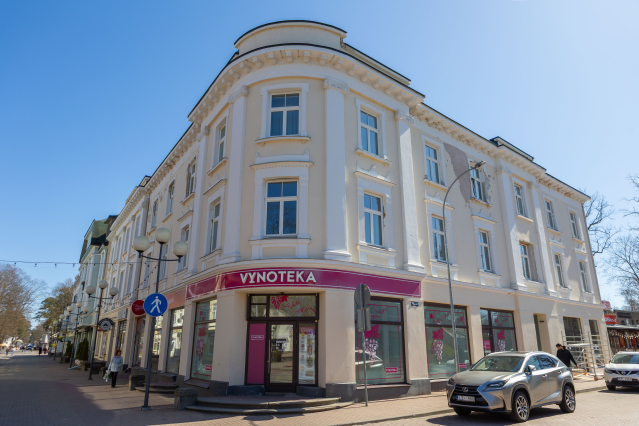
Between 1870 and 1895, this site was occupied by baker Štegers' homestead, which local farmers used as a marketplace. The Korovin shop located here was the first business in Majori to receive an official trading licence from the manor administration, giving rise to the name Tirgoņu Street (Merchants' Street). During the Soviet period, the street was renamed Kooperatīva Street.
The property contained two two-storey summer cottages belonging to Leopolds Vakers, along with sheds and an ice cellar. Various shops occupied the ground floors, while Vakers' bakery also operated on the premises.
It was from this bakery that the legendary fire of 1913 broke out, destroying the buildings of Horn's Concert Garden and many neighbouring houses.
Following the fire, a three-storey masonry building was erected in 1914. Shops occupied the ground floor, while hotel accommodation was provided on the upper two floors.
In the 1930s, the building housed O. Gebauer's Majori Hotel, the restaurant Mare-Lū, and the Riga Seaside Municipal Bank.
Towards the end of the decade, the premises of the Mare-Lū café were converted into a courthouse comprising a courtroom of approximately 100 square metres, offices for the judge and clerical staff, and a spacious waiting room. The entrance to the Jūrmala Magistrate's Court was located on Tirgoņu Street.
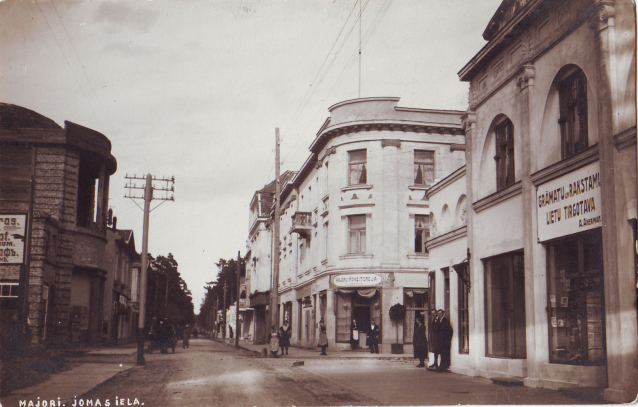
Contemporary newspapers described the courtroom as an impressive and dignified interior decorated in reddish-brown tones. Opposite the entrance stood an elevated platform with the magistrate's desk and chair, above which was displayed a sculpted national coat of arms flanked by wall lamps. The room was illuminated by an antique wooden chandelier that had been transferred from the regional court. The former street-facing café windows had been bricked up, leaving little indication to passers-by that a café had once operated there.
After the Second World War, the upper floors housed the district committees of the Communist Party and Communist Youth League until a new administrative building was constructed at Jomas Street 1/5. Later, the premises accommodated the court, prosecutor's office and law firms.
In 1952, a fish shop was established on the ground floor. It featured murals by artist O. Stankēvičs and an elaborate decorative interior. A fish tank was later added as part of the design. During the conversion of the premises into a gaming hall in 1999, much of the historic interior was concealed.
Today, the building accommodates a variety of shops and has recently undergone reconstruction. The building itself is protected as a local architectural monument of the early 20th century, while the interior of the former fish shop is recognised as a protected art monument.
18. JOMAS STREET 37 – KORSO SHOPPING CENTRE
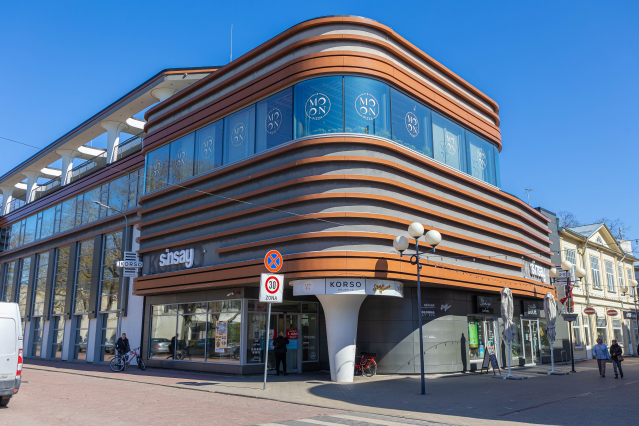
The first Horn Hotel stood on this site from 1870. In 1896, it became home to the first cinema in the Riga seaside resort area. Since the building was made of brick, it survived the great fire of 1913.
In the 1930s, a modern café called Mascotte opened here. Its name comes from French, meaning a lucky charm or mascot. The café featured Art Deco interiors, large floor-to-ceiling windows and a modern design by architects Alfrēds Karrs and Kurts Betge. It later became known as Korso.
The venue was famous for dance competitions, music contests, social events, Five O'Clock Tea gatherings, and beauty and tanning competitions. One of Latvia's jazz pioneers, Mihails Aļjanskis, led the orchestra that performed there. Korso was also an important venue during the annual Sea Festival, one of Jūrmala's major celebrations.
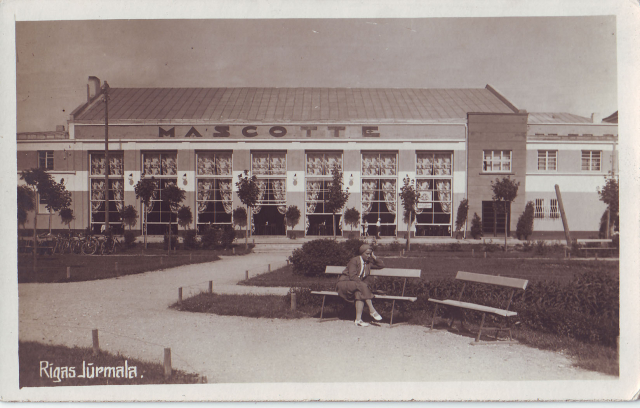
After the Second World War, the building housed the Korso cafeteria and the Seven Sisters restaurant, which was particularly popular among jazz enthusiasts.
In the 1990s, the Korso restaurant reopened. From 2000, the building was occupied by a branch of Hansabanka.
Following extensive reconstruction that began in 2013, the site reopened in 2017 as Galerija Korso, a shopping and entertainment centre with shops, restaurants, a cinema, a children's entertainment centre and a rooftop terrace. The project was designed by architect Didzis Krūmiņš.
19. JOMAS STREET 39
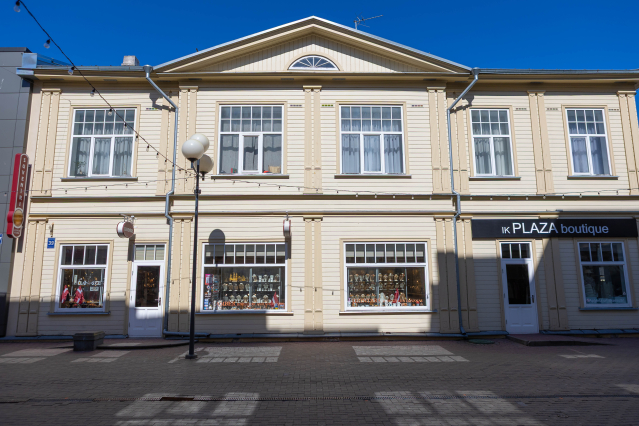
Before the fire of 1913, four summer houses owned by the Grīnvalds brothers stood on this site.
The present twin timber building was constructed in 1914 and is now a protected architectural monument.
Over the years, the building housed a jewellery and watch shop owned by Ābrams Rans, a watch repair workshop and a record shop. During the Soviet period, it was home to a stationery shop and the Ritms cultural goods store.
The building was fully restored in 2003.
20. JOMAS STREET 41
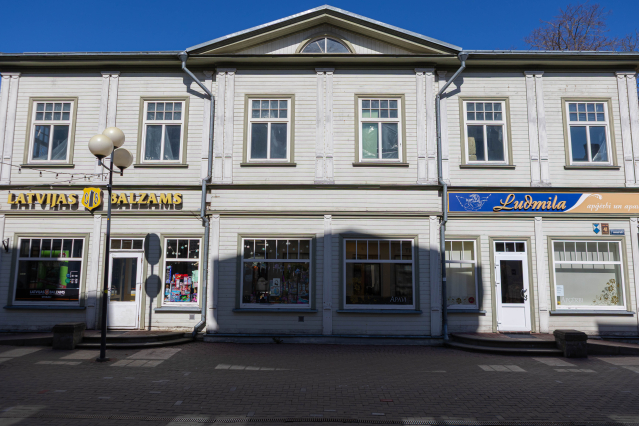
This twin timber commercial building was built in 1914 and is also a protected architectural monument.
From the 1930s, it housed the Majori Pharmacy, and during the Soviet period it served as the city's duty pharmacy.
21. JOMAS STREET 48
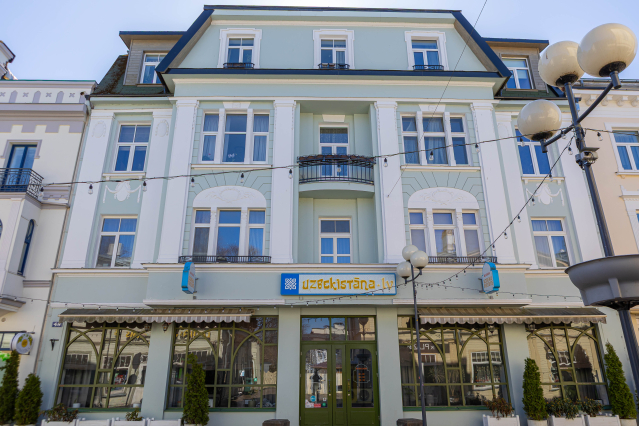
Before the fire of 1913, Heinrich Grenholm's summer house stood on this site, along with shops selling household goods and fashion items.
The present brick building was constructed in 1914, with shops on the ground floor and apartments above.
In the 1960s, it became a dairy shop called Veselība, or Health, selling milk, kefir, buttermilk, ice cream and dairy sweets.
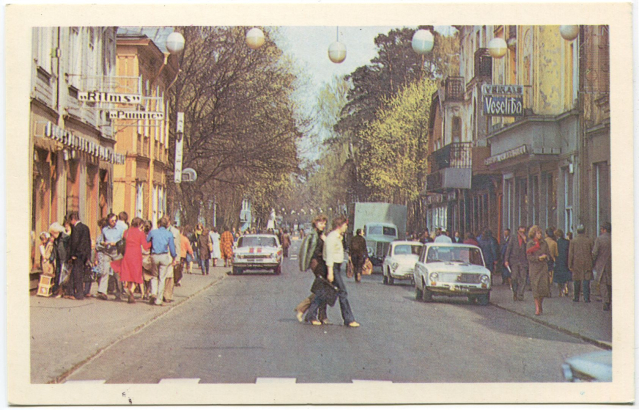
In 1991, it was replaced by the Pingvīns ice cream shop. At the time, the shop seemed strikingly modern and Western, serving soft ice cream directly from machines into waffle cones. New flavours such as kiwi and mango quickly made it especially popular with children.
Today, the building remains a protected architectural monument.
22. JOMAS STREET 50
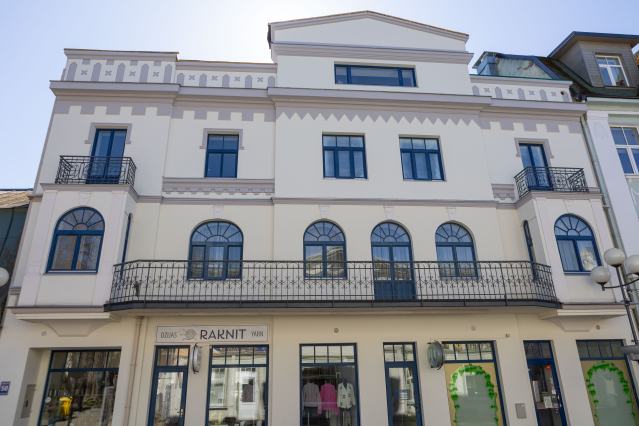
Before the fire of 1913, a summer house stood here, containing a pharmacy goods shop, a barber's shop and a hat shop.
A brick building was constructed on the site in 1914. Around 1930, it housed a Turkish café. In 1964, the Majori Restaurant opened here, offering live orchestral music and singers. In the 1970s, it became a diet cafeteria, later replaced by the Uzbek restaurant Uzbekistāna.
The building was renovated in 2001, with particular attention paid to restoring the balcony railings and rebuilding the bay windows. It is a locally protected architectural monument dating from the early 20th century.
23. JOMAS STREET 52
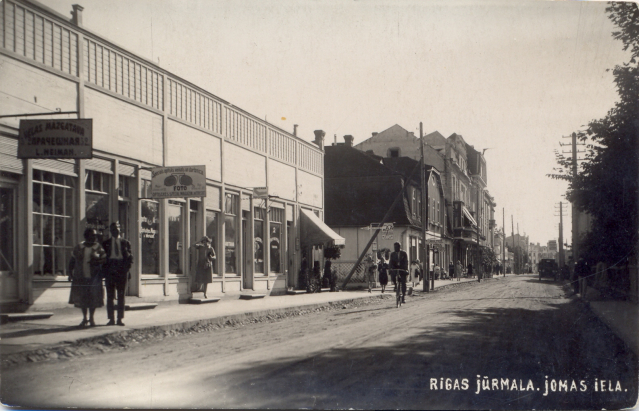
During Latvia's first period of independence (1918–1940), this site was home to a bakery and pastry shop.
During the Soviet period, the building housed several shops, including a men's accessories store and a furniture shop. In 1969, it also contained a beer bar and a cafeteria called Veselība, or Health.
24. JOMAS STREET 43 – EMPTY PLOT
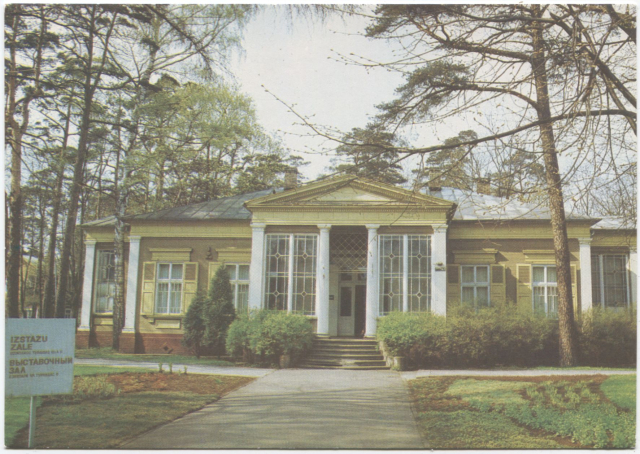
The building that once stood here no longer exists; only its foundations remain. It was an elegant Neo-Classical timber house, probably built around 1863.
In the second half of the 20th century, the building became Jūrmala's first museum. It initially served as a branch of the State Museum of the History of Riga and, from 1962, housed the exhibition halls and art department of the newly established Jūrmala Museum of History and Art.
After Latvia regained independence in the 1990s, the property was returned to its former owners. The building burned down in 2010 under unknown circumstances. After the fire, the foundations were preserved and the basement openings were covered.
25. JOMAS STREET 54
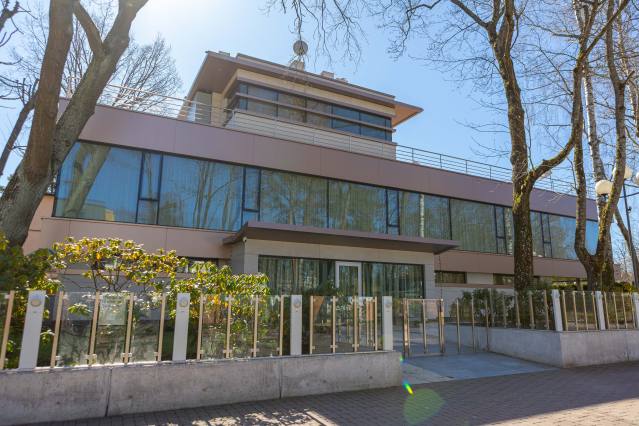
Before 1913, this site contained summer houses and shops owned by the heirs of Natālija Horna. After the well-known Horn's Garden fire, the buildings were rebuilt, although they have not survived to the present day.
In 1969, the Joma Café was built here. It had a modern design and a stylish interior. The second-floor hall seated around 100 guests and featured large windows with views of the surrounding area. On sunny days, visitors could also enjoy the rooftop terrace. Live music made it one of the most popular youth meeting places of the 1970s.
Between 2008 and 2013, the café was converted into a small hotel, and in 2020 a glass-covered extension was added.
26. JOMAS STREET 56
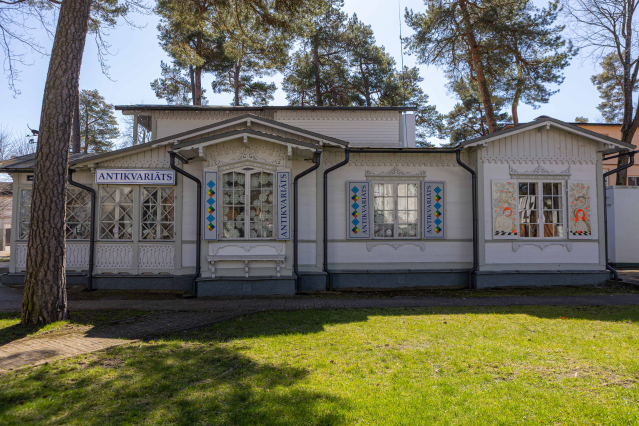
At the beginning of the 20th century, Dr Thilo's water-treatment centre was located here. The original summer house has survived.
From the 1960s to the 1980s, the building housed the Jūrmala Travel and Excursion Bureau, where tours were organised and guides were trained. It also contained the city chess club and a branch of a scientific balneology research laboratory.
Today, the building is privately owned and used for small shops. It is a nationally protected architectural monument dating from the early 20th century.
27. JOMAS STREET 58
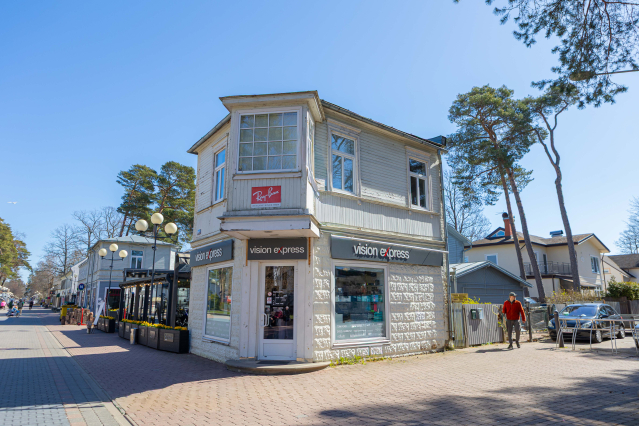
This building was constructed around 1900. The ground floor originally housed a shop, while the upper floor contained an apartment with a balcony.
The balcony is supported by carved wooden brackets in the shape of dragons, reflecting the influence of Art Nouveau architecture in Jūrmala.
During the Soviet period, the building accommodated a holiday apartment, a shoemaker's workshop and a flower shop. For many years, a well-known mural depicting a coffee cup advertised a café on the premises, although it has since been painted over. Today, the building is occupied by an optical store.
Another building on the property houses the café Lokāls Veranda. In 2022, a summer terrace was added, designed in harmony with the historic character of Jomas Street and evoking the atmosphere of a traditional Jūrmala veranda.
28. JOMAS STREET 47/49 – HOTEL JŪRMALA
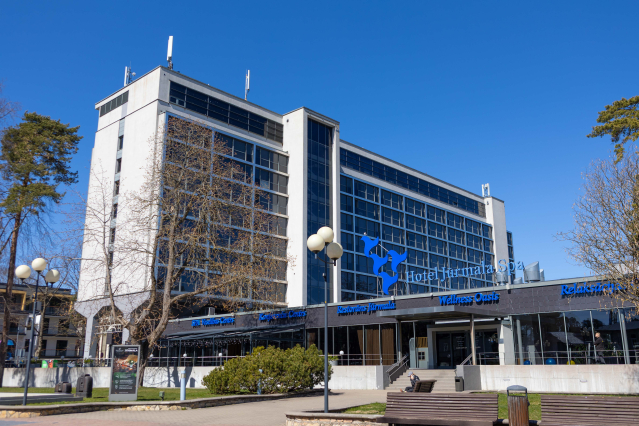
The former shop buildings on this site were demolished in the early 1970s.
Hotel Jūrmala opened on 30 April 1974. The nine-storey hotel contained 260 rooms and could accommodate 360 guests. Its restaurant had seating for 150 visitors.
In the late 1980s, the hotel became known for its popular variety shows. The hotel bar hosted disco evenings, while an open-air café on the second-floor roof terrace served ice cream and cocktails beneath striped umbrellas.
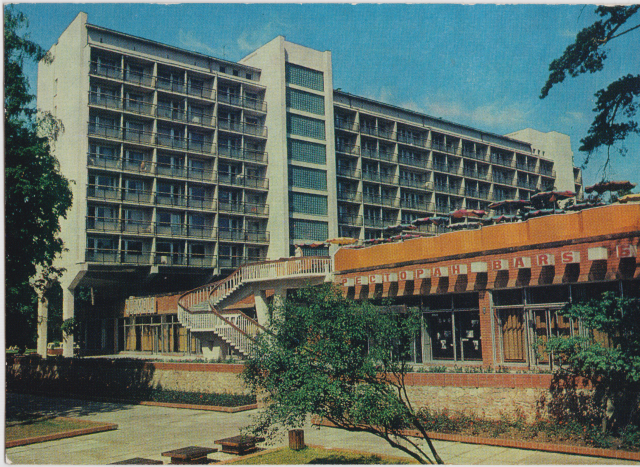
In the early 21st century, the property entered private ownership. Following extensive renovation works, it reopened in 2005 as Hotel Jūrmala SPA, which continues to operate today.
Near the hotel stands a discreet sculpture group entitled Trijatā (The Three Together), created in 1987 by Eduards Geners and Māra Genere.
29. JOMAS STREET 60
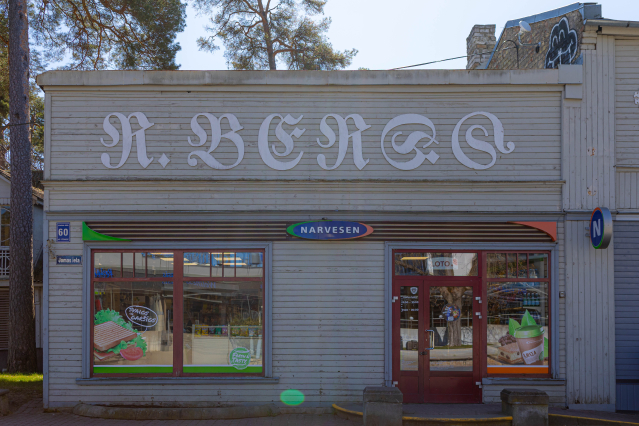
This building was constructed in the early 20th century and belonged to R. Bergs, the owner of a woodworking company. His name can still be seen in the decorative details of the façade.
The premises have always been used for retail purposes. During the 1980s, the building housed a shop specialising in porcelain and ceramic tableware.
30. JOMAS STREET 62
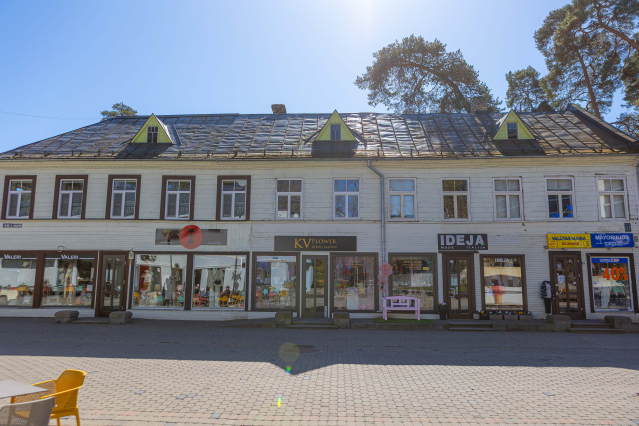
During Latvia's first period of independence, various shops operated here, including a store selling household goods and tableware.
In the 1950s, the premises housed a tailoring workshop specialising in clothing and footwear.
In 1969, a folk art shop called Rotkalis (The Blacksmith) opened here. Its interior was designed to resemble a traditional rural blacksmith's workshop, featuring stone walls, red brickwork, an oak log and an anvil.
The shop offered a wide selection of traditional Latvian crafts, including pottery, amber jewellery, decorative tableware, leather belts, straw mats and furniture.
Visitors could purchase items, place custom orders and receive advice on furnishing and decorating their homes.
31. JOMAS STREET 53
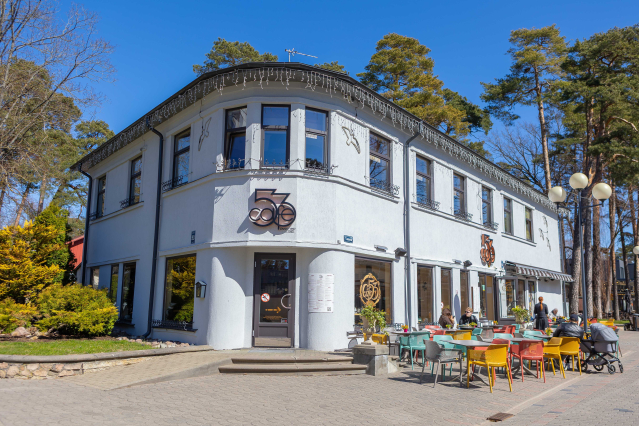
During Latvia's first period of independence, this address was occupied by a grocery store and a photography studio. During the Soviet period, the building housed clothing and shoe tailoring workshops, as well as a dry-cleaning service. Today, the popular café Cafe 53 continues a long tradition of commercial activity on the site.
32. JOMAS STREET 64
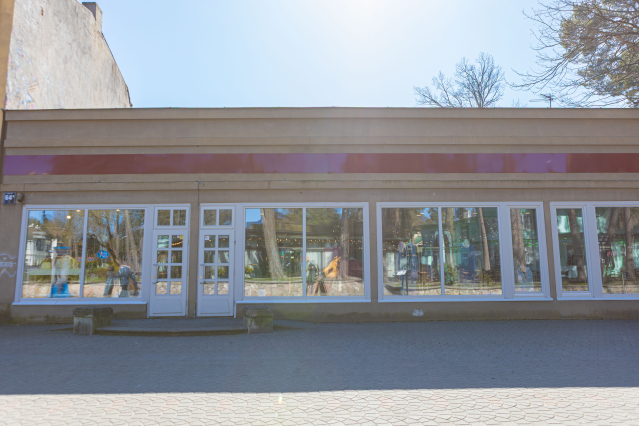
This building was constructed in the 1930s. In 1966, a toy shop called Buratino opened here. It sold a wide variety of toys, including wind-up monkeys, toy cars, inflatable crocodiles and horses, cocktail-mixing toys and numerous stuffed animals. The display windows featured beloved storybook characters such as the Three Little Pigs, Moomin, Brother Rabbit and the Ugly Duckling. Foreign visitors often purchased dolls dressed in traditional Latvian folk costumes as souvenirs.
33. JOMAS STREET 55
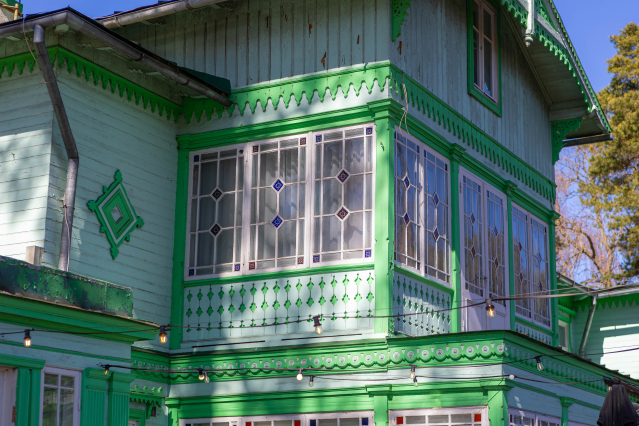
This building is protected as a local architectural monument. Constructed in the early 20th century as a two-storey boarding house, it is distinguished by its rich wooden decorative detailing. Several original interior features have survived, including the staircase and a ceramic fireplace stove.
During the Soviet period, the property became part of the Draudzība boarding house complex. It was privatised in 1997 and restored in 2001. Today, the building operates as a hotel. Since 2002, temporary structures on the property have housed a restaurant.
34. JOMAS STREET 64A – ALUS KRODZIŅŠ
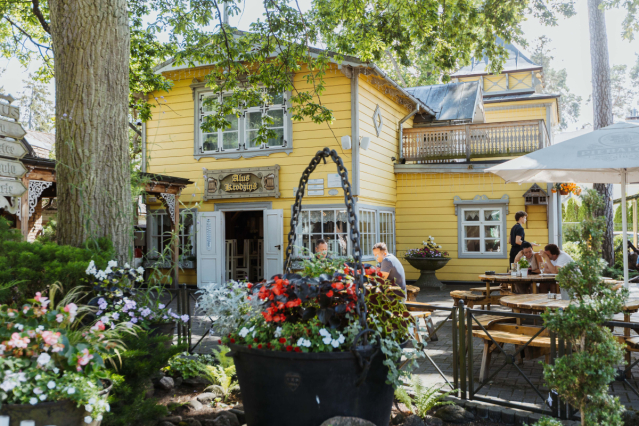
One of the oldest buildings on Jomas Street, this former summer cottage dates from approximately the 1860s. In the 1930s, it housed a bicycle repair workshop. When buses still travelled along Jomas Street, there was a bus stop nearby and a soda-water machine in the courtyard. During the Soviet period, the building served as a holiday cottage for employees of various organisations.
In 1993, the café Alus Krodziņš opened here. After the property entered private ownership, its owner undertook a careful restoration. Many historic elements characteristic of Jūrmala architecture — doors, windows, stained glass, carved woodwork and fireplaces — were rescued from other historic buildings, flea markets and even discarded building materials.
Original second-floor windows with hand-blown glass have survived to this day. During restoration works, newspapers dating from 1880 were discovered beneath the wallpaper. The courtyard was landscaped while preserving several impressive oak trees estimated to be around 300 years old. These trees are currently being considered for official heritage protection status. Today, the property contains a guesthouse and a café serving traditional Latvian cuisine.
35. JOMAS STREET 64A – SHOP BUILDING
This building was constructed in the 1920s and originally served as a telephone exchange. In 1938, a shop belonging to the Union confectionery and chocolate factory opened here. During the Soviet period, the premises operated as a grocery store with a small café serving coffee, cakes and sandwiches. Following extensive renovation, the café Promenāde opened here in 1992, offering traditional Latvian dishes. Today, the building continues to serve commercial purposes as a retail shop.
36. JOMAS STREET 66
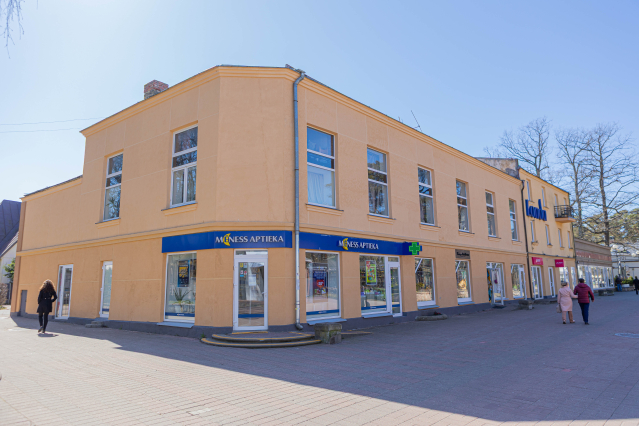
In 1929, one of Jūrmala's most popular cafés, Marseille, operated on this site. Every evening, guests could enjoy live orchestral music and cabaret performances, while the café remained open until 2 a.m.
In 1930, the building was transformed into the Eden Cinema, one of the most modern cinemas in the area at the time. Its interior featured exotic decorative elements, and the auditorium was designed to resemble a balcony overlooking islands, cliffs and sailing ships. Films were screened daily.
After the Second World War, the cinema was renamed Dzintarkrasts. It operated year-round, although the lack of adequate ventilation often made the auditorium uncomfortably warm during summer.
Following the opening of the new Jūrmala Cinema in 1964, the building gradually acquired new functions. Over the years, it housed a club, an engraving workshop, a hat-making workshop and a hair salon.
During the 1990s, the premises accommodated a beauty salon and a video rental shop. Today, the ground floor is occupied by retail premises, while apartments are located on the upper floor.
37. JOMAS STREET 57
Around 1969, one of the largest grocery stores in Majori operated at this address. It remained open every day without a lunch break, serving both residents and holidaymakers.
In the 1980s, the building housed a newspaper kiosk and a shop for stamp collectors.
Since the 1990s, various restaurants and nightclubs have occupied the premises. Among the most notable were the stylish café De La Presse and, later, the Russian restaurant Slāvu.
The present building was completed following reconstruction in 2023.
38. JOMAS STREET 61
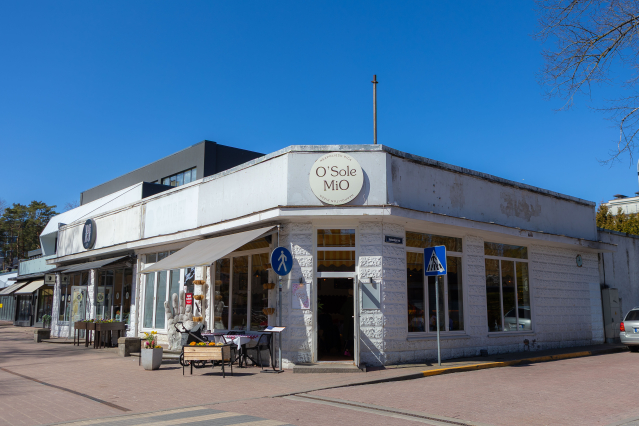
Before the Second World War, this address was home to the Danciger fabric shop and a dry-cleaning collection point.
The Danciger family built a successful textile and dry-cleaning business that became renowned throughout the Russian Empire. Their reputation was so widespread that stained garments were commonly said to need to be "taken to Danciger".
After the First World War, the family rebuilt its business in Riga and expanded into textile manufacturing. Their factory became one of Latvia's leading producers of woollen fabrics and yarn.
The family also supported cultural institutions and charitable initiatives. Later, they emigrated to Sweden. During the Soviet period, their factory was nationalised.
During the Soviet era, the building on Jomas Street housed an electrical goods store, a repair workshop, a photography studio and a watch repair shop. After Latvia regained independence, the premises became a laundry.
39. JOMAS STREET 63
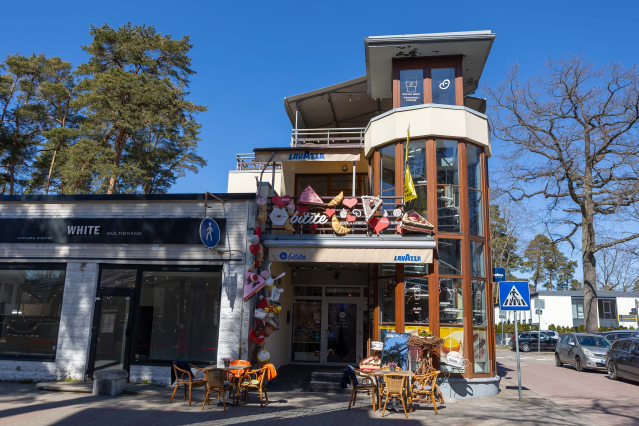
Part of the original summer-cottage development has survived and is now occupied by small shops.
In 1973, an ice cream café called Four Brothers opened on the corner. Its name playfully referenced Riga's famous medieval building complex known as The Three Brothers. The café consisted of four identical pavilions with seating for fifty visitors.
Later, the premises became home to a popular fruit and vegetable shop.
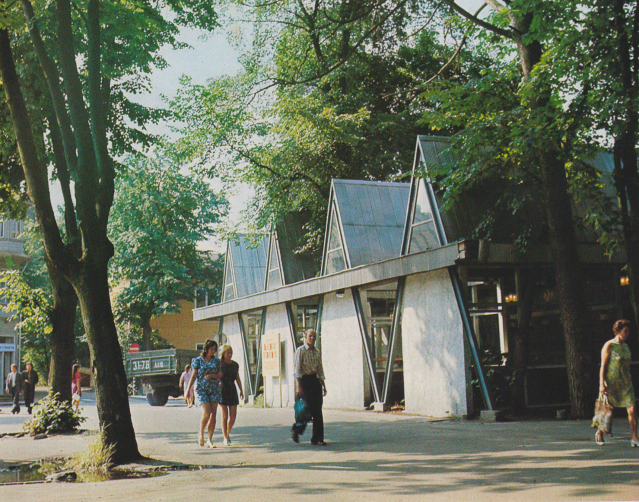
The café building was renovated in 2006.
Until 2024, a restored souvenir kiosk stood beside the street. Originally designed in the National Romantic style with a reed roof, it opened in 1958 as a souvenir shop. It later served as a currency exchange office before standing vacant for many years and eventually being demolished.
40. JOMAS STREET 76
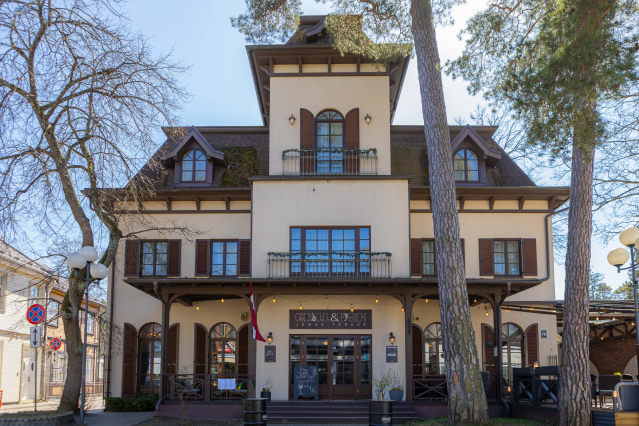
Originally a modest timber building, this property was remodelled during the Soviet period.
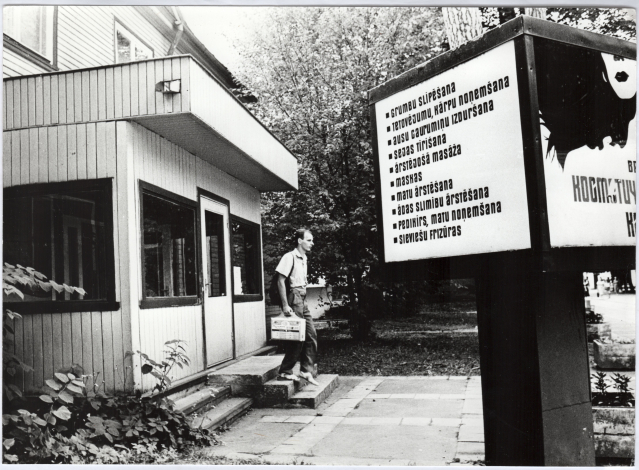
In 1980, a medical cosmetics clinic opened here, offering a wide range of treatments, including wrinkle reduction, tattoo and wart removal, facial cleansing, therapeutic massage, cosmetic masks, hair and skin treatments, pedicures, waxing and women's hairdressing services.
In 2007, the building was redeveloped as a leisure and accommodation complex. Although contemporary in construction, it was designed to reflect the character of Jūrmala's historic architecture.
Today, the restaurant Grill & Fish occupies the ground floor.
41. JOMAS STREET 78
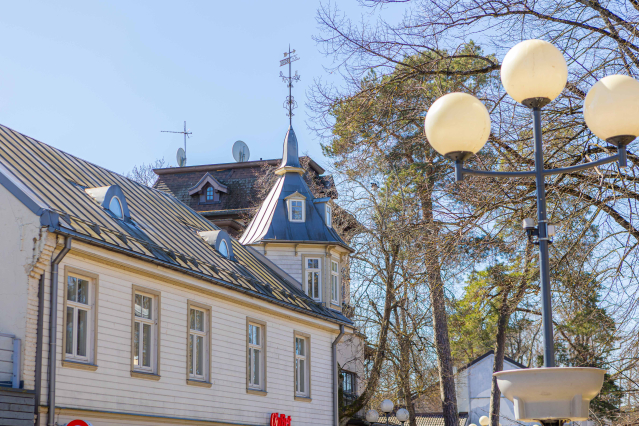
The building is protected as a local architectural monument. It is a two-part boarding-house-type building from the early 20th century, distinguished by a corner tower. The ground floor was used for shops, while the upper floor contained residential premises. At the rear, facing Jāņa Pliekšāna Street, a large two-storey residential extension with verandas was added.
During Latvia's first period of independence, the building housed a grocery store and a photography studio. During the Soviet period, it contained a shop selling discounted televisions, radios, tape recorders and watches, as well as a sports goods store and a shoe repair workshop.
The building underwent major renovation in 2005. A popular mural depicting an orange once adorned the firewall wall, but it has since been painted over.
42. JOMAS STREET 65/67
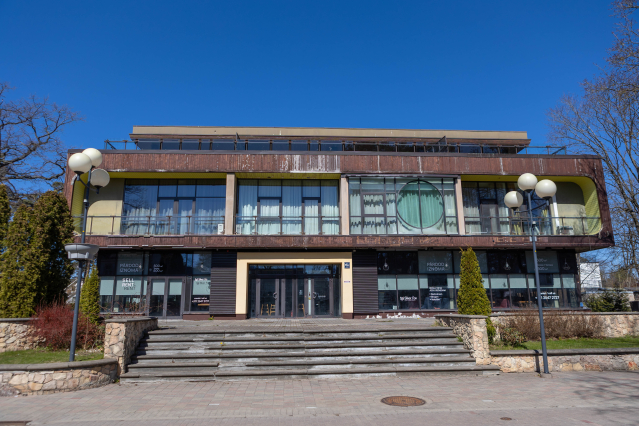
In 1968, the Majori department store was built on the site of earlier shop buildings, designed by architect Josifs Goldenbergs. It was a compact concrete-and-glass structure housing shops that sold knitwear, footwear, clothing, haberdashery, souvenirs and fabrics.
Between 2005 and 2008, the Majori department store was reconstructed as a guesthouse according to a design by architect Agris Padēlis-Līns. In 2009, the guesthouse façades were renovated, and a terrace was added to the roof of the extension.
Architect and interior designer Josifs Goldenbergs (1907–1984) is known as one of the pioneers of Soviet Modernism in Latvian architecture. In Jūrmala, his projects included the access route to the sea at the end of Turaidas Street near Dzintari Concert Hall, the glass pavilion of the Kaija café on Dzintari Beach, and the legendary restaurant Jūras Pērle. In Riga, among the best-known projects he contributed to were the Bērnu pasaule department store, the sales hall of the Sakta retail company and the Piena restorāns in Kronvalda Park. Most of these buildings have either been lost or significantly altered.
Next to the department store, a flower shop was built in 1986. It sold roses, gladioli, carnations and asters grown in eight Jūrmala market gardens and in the greenhouses of the Uzvara fishing collective farm. In the 1990s, the Delfīnija flower shop still operated here. Later, the premises housed a gaming hall, while today a café has opened on the site.
43. JOMAS STREET 82
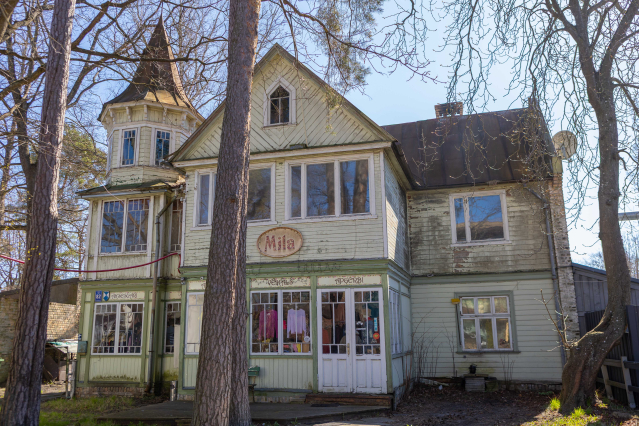
The building is protected as a local architectural monument dating from the early 20th century.
This residential building was constructed in the early 20th century as a large two-storey structure with features of the Art Nouveau tradition, an asymmetrical composition and a tower characteristic of Jūrmala architecture.
44. JOMAS STREET 86
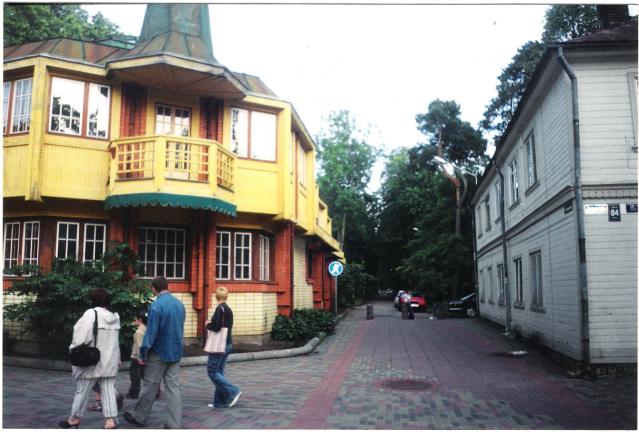
In the 1950s, a branch of the Korso restaurant operated here as a shashlik café. Contemporary newspapers wrote that the branch had no shortage of visitors: it offered shashlik, dry wines and pastries, the premises were clean, the waiters polite, and the shashlik genuinely delicious.
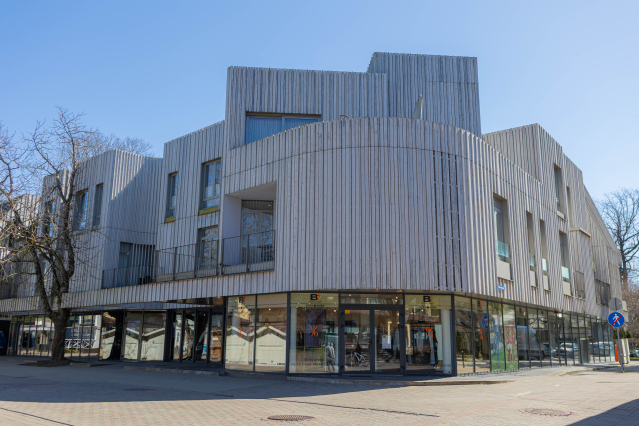
In 1986, on the site of a demolished summer cottage, a yellow-brick building was constructed for the restaurant Orients. Its main façade extended both along Jomas Street and into the neighbouring plot. This spacious Caucasian restaurant, with three dining halls and a bar, attracted many guests from Riga as well, since this type of cuisine was still rare at the time.
The restaurant building was sold in 2001 and demolished in 2013. A guesthouse now stands in its place, designed as a corner volume with extensive glazing.
45. JOMAS STREET 77 – LETTIA HOTEL
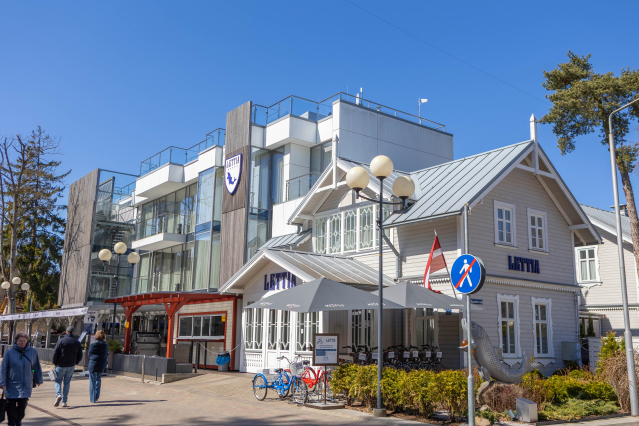
A summer cottage belonging to actor and theatre director Alekšis Mierlauks, whose real name was Alekšis Frīdenfelds (1866–1943), once stood on this site.
Today, a hotel building has been newly constructed in its place as a replica of the historic structure, preserving the original volume and architectural character. In 2015, a new contemporary extension was added.
46. JOMAS STREET 90
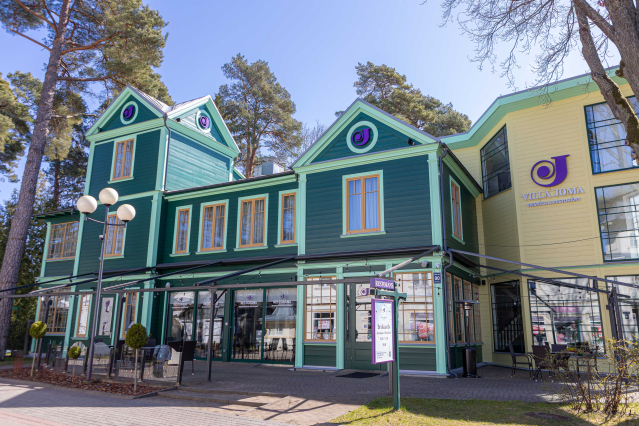
This boarding-house-type building from the early 20th century once belonged to von Kleist.
During the Soviet period, it formed part of the Majori holiday home complex. In 2001, the building was reconstructed according to a design by architect Uģis Šēnbergs and converted into the Villa Joma Hotel.
The building is protected as a local architectural monument.
47. JOMAS STREET 92
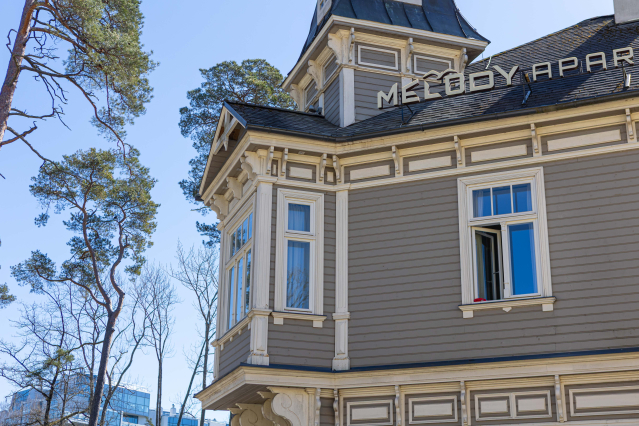
This property contains two boarding-house-type buildings from the early 20th century, with shops on the ground floor. Their corner towers symmetrically define the site at the intersecting streets, while between them stands what may be the oldest building on the property.
The two outer buildings, Building No. 1 and Building No. 2, are protected architectural monuments. Of particular value are their volumes with towers and façades, which visually mark the end of the historic development along Jomas Street. Rich bands of carved wooden details, window surrounds and brackets make these buildings striking examples of Jūrmala's wooden architecture. Their images have often been used in publications to represent the city's earlier wooden architectural heritage.
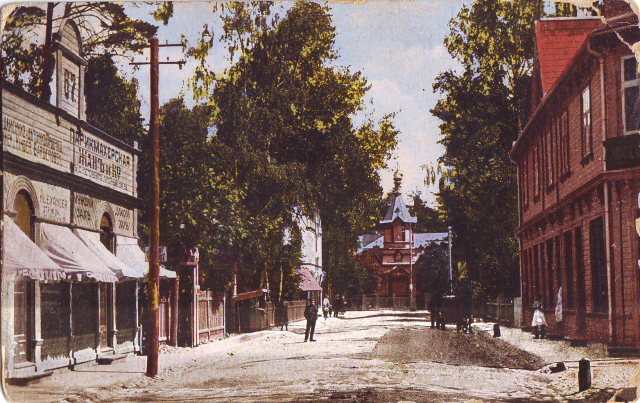
During Latvia's first period of independence, various shops operated here.
During the Soviet period, Building No. 2 contained apartments and service establishments, including a shoe repair workshop and a women's hairdresser's salon. Building No. 1 housed the Rīgas ekspresis household goods rental point, where holidaymakers could rent folding beds, chairs, inflatable mattresses, balls, badminton sets, chess sets, sports equipment, radios, blankets, bicycles, refrigerators, televisions, tents and tableware — everything that might be needed for a summer stay at the resort.
48. JOMAS STREET 85
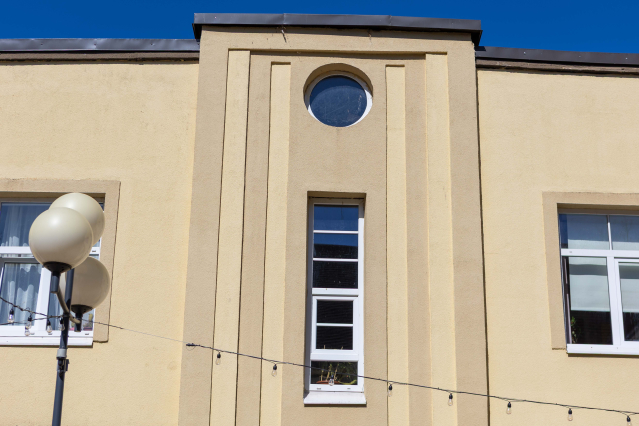
This commercial building was constructed in the 1930s on the commission of its owner, K. Mīlmanis. It stands on the corner of Jomas Street and Turaidas Street, then known as Robežu Street.
The building's volume follows the principles of Functionalism, evident in its horizontally extended composition with vertical contrasts. Its façade reveals the transition from late Eclecticism to early Functionalism. The symmetry of the overall volume and its strict geometry point to the "new rationalism", while certain details — the emphasised central axis and the small round window above it — retain a decorative quality inherited from earlier traditions and display Art Deco features.
During Latvia's first period of independence, the building housed an ice cream and fruit shop, a photographic supplies store and a photographic studio. During the Soviet period, a hairdresser's salon and photo studio occupied the ground floor, while the upper floor housed a household services office.
49. ENVIRONMENTAL OBJECT GLOBE
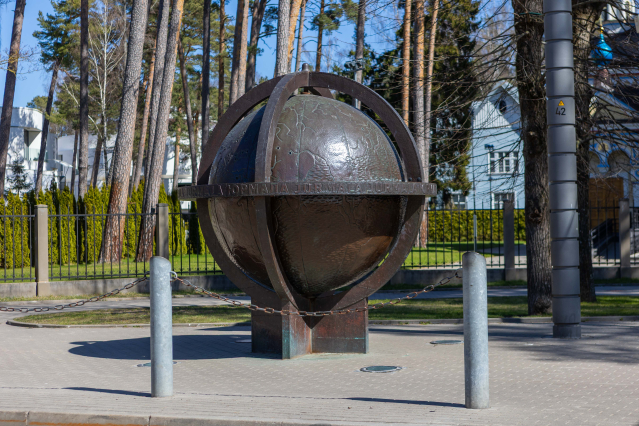
The historic environmental object Globe, measuring two metres in diameter, is considered the largest globe in Latvia.
It was installed in the early 1970s and has therefore become, for many visitors to the city, a symbol of that era. This is also reflected in the countries shown on the globe's map. Since the 1970s, Jūrmala's sister cities have been marked on the map with illuminated circles.
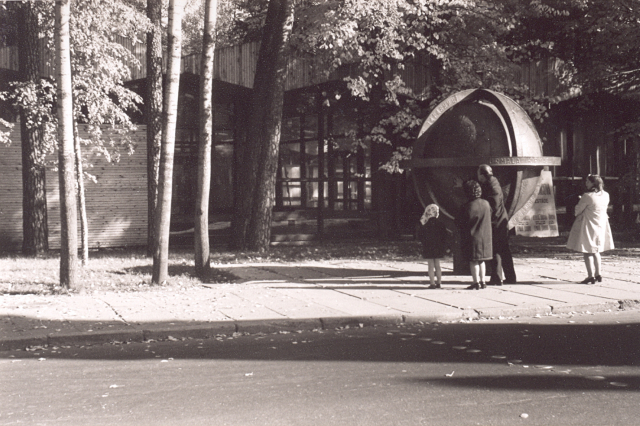
The globe was reconstructed in 2003. In 2016, it was restored by commission of Jūrmala City Council.
To protect the load-bearing structure from the effects of the environment, galvanised steel was used in its restoration. Some of the copper cladding panels damaged over time were restored, while others were newly made using historic copper-working techniques. The panels were mounted on a newly fabricated equator, meridians and load-bearing structure of the globe. The movement and lighting mechanisms were also restored.
50. ORTHODOX CHURCH OF THE KAZAN ICON OF THE MOTHER OF GOD
In the late 19th century, the number of permanent residents in the Riga seaside resort area was growing, and there were many Orthodox believers both among residents and holidaymakers. There was no nearby church, while travelling to Riga, Dubbeln, or Dubulti, or to the Church of Saints Peter and Paul in Ķemeri required considerable time and expense using the transport available at the time.
Fundraising for the construction of a new church in Edinburgh was announced in 1890. In the spring of 1893, A. P. Kīzelbašs, architect of the Riga Educational District, prepared the design, working drawings and cost estimate free of charge. A plot between Maiorenhof, or Majori, and Edinburgh, or Dzintari, was chosen as the construction site.
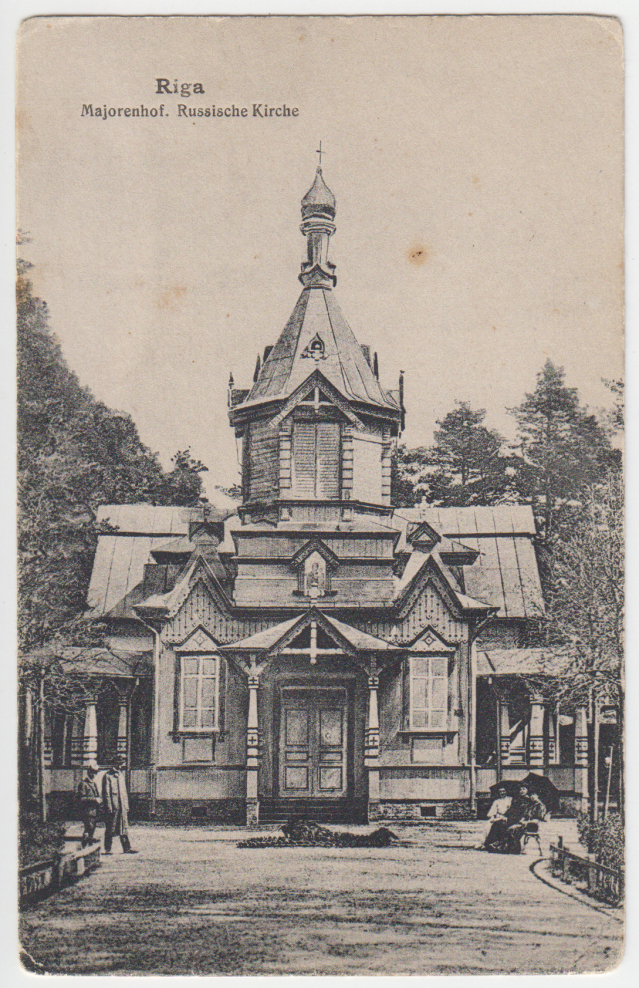
The church was built quickly. Just one year after the consecration of the site and the laying of the foundation stone, construction was complete. The church already housed an icon of Our Lady of Kazan from the Moscow school of icon painting, and it received gifts including carpets, a silver censer, chandeliers and various liturgical objects. The candle counter was donated by the provincial architect V. I. Lunskis.
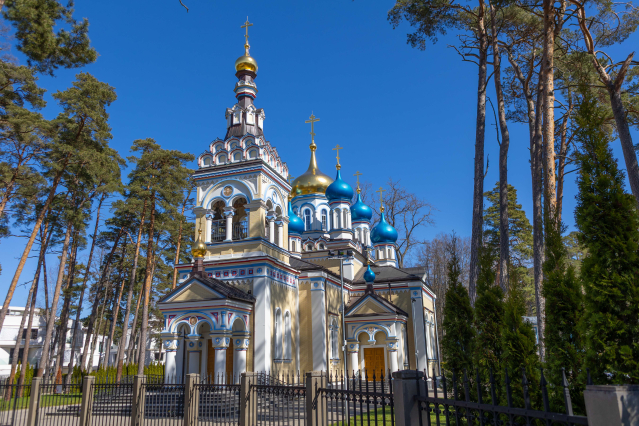
The Edinburgh church was consecrated on 23 June 1896 in honour of the Kazan Icon of the Mother of God. It was a wooden cruciform church with two gilded domes, visible both from the sea and from the resort's main street.
From 1913, services were held daily, including in Latvian and German. In 1938, the parish council decided to rename the Edinburgh church as the Riga Seaside Orthodox Church of the Kazan Icon of the Mother of God.
During the Second World War, the church continued to function, despite difficult conditions. An unexpected turn came in 1962, when a decision was prepared to close several churches in Latvia. The Edinburgh church suffered the same fate. The church, which had survived the Revolution of 1917, two world wars and repeated changes of power, was demolished within a single day in peacetime by order of the authorities.
Parish members managed to secretly remove several icons, liturgical objects and sacred books and transfer them to the Orthodox church in Dubulti, where they are still preserved.
Exhibition pavilions were later built on the site of the demolished church, also housing a museum of historic vehicles. The exhibition halls became branches of the Jūrmala Museum, hosting exhibitions of painting, textile art, ceramics, metalwork and sculpture, as well as festive fairs. The café Globuss also operated on the site.
In the 21st century, the church gradually regained its land, and in 2019 the newly built church was opened here. Today, it is open every day.
Historical images from the Jūrmala Museum collection.